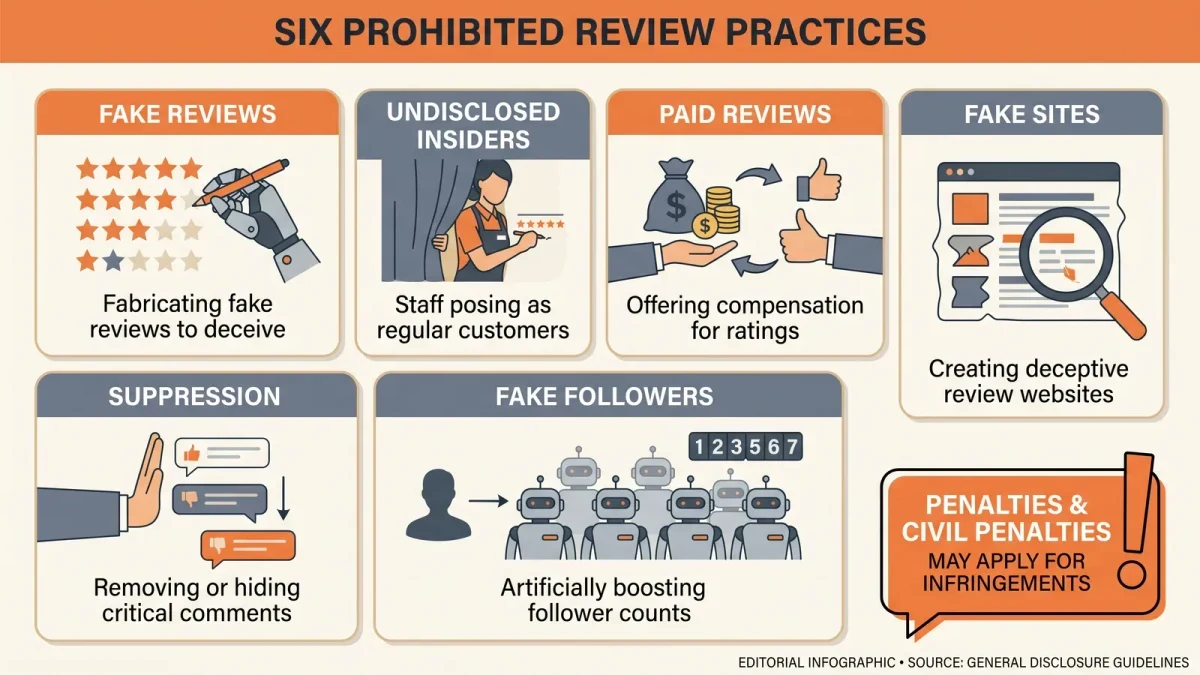

The fastest filter: ignore the five-star and one-star reviews entirely and read only the three-star ones — that's where detailed, verifiable complaints about battery life, app quality and warranty support actually live. Fake reviews cluster at the extremes; genuine mixed reviews cluster in the middle. And since October 21, 2024, fake reviews aren't just shady — they're a violation of the FTC's rule on consumer reviews and testimonials, which bans buying, selling and fabricating them.
What did the FTC rule actually change?
The FTC's final rule on Consumer Reviews and Testimonials, effective October 21, 2024, prohibits businesses from creating or selling fake reviews, suppressing honest negative reviews, and buying positive ones — with civil penalties per violation. The agency documented a wave of cases since, including a February 2025 settlement announcement against a store selling fake reviews and warnings to platforms in October 2025 demanding identification of review brokers. For you, the shopper, it means reporting fakes now goes somewhere: the FTC accepts reports at reportfraud.ftc.gov.
What are the signs of a fake gadget review?
- Review timing: dozens of five-star reviews inside a few days, often right after launch — real reviews accumulate slowly.
- Generic praise: "great product, fast shipping" with no mention of the actual device — fake writers rarely know the product.
- Reviewer history: click the profile; a history of only five-star reviews across unrelated categories is the documented fingerprint of review farms.
- Incentivized disclosure: honest incentivized reviews say "I received this product for free" — that's allowed with disclosure; undisclosed ones violate the FTC rule.
- Verified-purchase filter: use the listing's own "verified purchase" filter where available, and cross-check the product's rating on a second retailer.
Where else can you check before buying?
For gadgets specifically, professional measurement outfits publish methodology — unlike anonymous reviewers. Cross-reference the listing against such reviews, the manufacturer's own spec sheet, and community forums where owners post long-term updates. If a $40 product claims specifications matching a $200 one, the spec sheet is the tiebreaker, not the star rating.
What do you do when you spot fakes?
- Report the review through the platform's own reporting tool.
- Report the seller to the FTC at reportfraud.ftc.gov — the agency documented using consumer reports to build cases under the 2024 rule.
- Take your money elsewhere: a listing drowning in fakes tells you how the seller treats customers generally.
The takeaway
Read the middle-star reviews, check reviewer histories, and remember the FTC rule makes fake reviews a documented violation worth reporting. What no rule fixes: your own two minutes of skepticism. That part is on you — and it works.